Chile C&I BESS Market Status & China–Chile Cooperation Guide
Why local distributors and EPCs should look past the 9 GW utility-scale gold rush—and where the real opportunity sits.
If you have been watching Chile’s energy transition from the sidelines, the headline numbers are impossible to ignore. By the end of 2025, the country had 1.5 GW / 6.2 GWh of battery storage in operation, up 87.5% year-on-year. Another 6.8 GW / 25.3 GWh is under construction. The government originally aimed for 2 GW by 2030; that target will be hit in January 2026—four years early.
But here is what the press releases do not tell you: over 95% of that capacity is utility-scale. Engie, Atlas Renewable Energy, Sungrow, and Wärtsilä are fighting over massive front-of-the-meter projects while a far more interesting story is unfolding behind the meter. Commercial and industrial (C&I) distributed storage accounts for less than 5% of installed capacity. It is also the fastest-growing segment, the least contested, and—if you are a Chilean distributor, EPC, or engineering firm—the most practical place to build a business in the next three years.
This guide explains why, and how to capture it.
The Problem: A System Drowning in Cheap Solar
Chile’s northern grid is one of the best solar resources on the planet. It is also a case study in what happens when generation outpaces flexibility.
In 2024, Chile curtailed 5,642 GWh of wind and solar generation—19% of total renewable output. To put that in perspective, that is enough electricity to power the entire Antofagasta Region for a full year. Cumulative curtailment losses since 2022 now exceed $562 million. The power is there; the system simply cannot absorb it during midday peaks.
At the same time, industrial electricity tariffs rose by roughly 60% between 2024 and 2025. For factories, cold storage facilities, and mining suppliers, the pain is concentrated in one line item: the cargo por demanda máxima (demand charge), which can represent 30% to 70% of a monthly bill. These charges are calculated based on the highest 15-minute power draw in a billing period. One bad afternoon can lock in a punitive rate for the entire month.
The result is a market with two parallel crises: too much cheap, wasted solar on the supply side, and punishing demand charges on the consumption side. Batteries solve both. They absorb midday overgeneration and discharge during evening peaks, capturing arbitrage spreads while flattening a facility’s demand profile.
The economics have finally caught up with the need.
The Economics: Why Now, and Why Chinese Systems
For years, the barrier to C&I storage in Chile was capital cost. That barrier is collapsing.
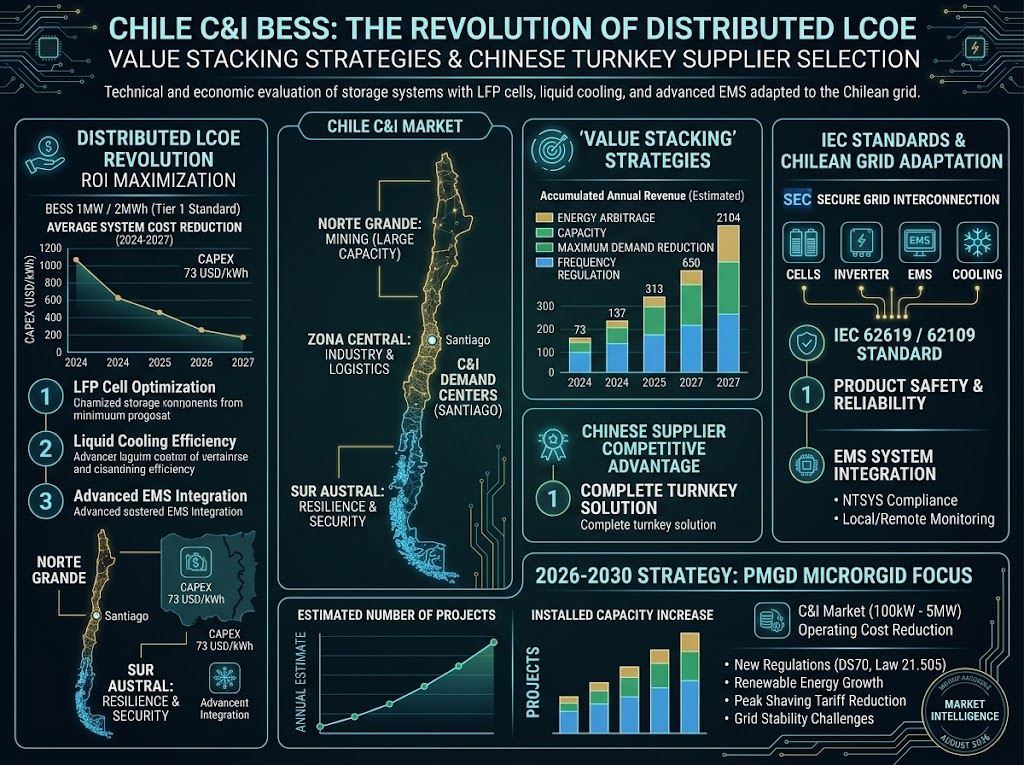
BloombergNEF’s 2025 survey shows the global average stationary storage battery pack price fell to $70/kWh, down 45% year-on-year. But the real story is the geographic divergence. A Chinese 4-hour turnkey system now averages $73/kWh. In Europe, the equivalent system costs $177/kWh. In the United States, $219/kWh.
That is not a marginal difference. It is a structural advantage. At one-third the cost of Western brands, Chinese systems change the project finance math entirely.
In northern Chile, the revenue case is even more compelling. Peak-to-valley spreads at nodes in the former SING region routinely reach $85–105/MWh. A 5-hour system cycling daily can generate $95,000–125,000/MW·year in pure arbitrage revenue, before counting demand-charge savings or capacity payments. Central-zone peak-shaving projects using 2-hour systems are now paying back in 4–6 years—and that payback period keeps shortening as tariffs rise.
For local distributors, this cost shift creates a viable product. A 500 kW / 1 MWh peak-shaving system, delivered and installed in the Santiago metro, can be built for roughly $170–185/kWh all-in. The same system built with Western equipment is often economically unviable. The Chinese price point makes the project bankable.
The Policy Tailwind: Latin America’s Most Complete Storage Framework
Chile did not stumble into this opportunity. It built it deliberately.
Law 21.505 (2022) established storage as an independent market actor, allowing batteries to earn revenue in both energy and capacity markets. DS 70/2023 introduced capacity payments with tiered recognition by duration—4-hour systems receive ~95% recognition, 5-hour systems 100%. A standalone storage project can now earn $45,000–55,000/MW·year in capacity revenue alone, stacking on top of arbitrage.
The 2026/01 power supply tender (2,835 GWh/year, 15-year contracts, storage accepted as compliance collateral) explicitly rewards evening-peak delivery—effectively writing a revenue floor for solar-plus-storage hybrids. And at the distributed level, the DS 88 amendment allows existing PMGD solar plants to add batteries and convert to hybrid projects, unlocking a retrofit market of 3.5–3.9 GW of operating distributed generation.
Perhaps most importantly for C&I players, the threshold for “free customers”—those who can negotiate directly in the spot market—dropped from 500 kW to 300 kW in 2025. The industry is pushing for 200 kW, or even 100 kW. Every threshold reduction adds thousands of new commercial and industrial facilities to the addressable market.
The regulatory identity of distributed storage is being formalized in real time. First movers will capture the first wave of benefits when the new rules take full effect.
The Competitive Gap: Everyone Is Upstream
Walk through the project pipeline in Chile and you will see the same names: Engie’s 116 MW/660 MWh Tocopilla BESS. Atlas’s 200 MW/800 MWh BESS del Desierto. Sungrow’s 960 MWh contract with BHP. These are impressive projects. They are also entirely utility-scale.
The C&I segment—projects from 100 kW to 5 MW—has been left behind. Large international OEMs like Tesla, Fluence, and Wärtsilä focus on containerized utility systems with long lead times and high minimum order quantities. They are not designed to quote a 500 kWh factory peak-shaving system in Coquimbo. Chinese tier-1 brands (CATL, BYD, Sungrow, Trina) dominate equipment supply to these large projects, but their direct sales teams serve Engie and Atlas, not local distributors.
This leaves a structural gap in the market: C&I customers want Chinese price-performance, but they need local solution design, integration, logistics, and commissioning. Someone has to build the bridge between the factory floor in China and the meter room in Antofagasta. That bridge is the business opportunity.
How to Partner: Four Models That Actually Work
Not every local player should approach the market the same way. Your starting model should depend on what you already own: customer relationships, technical capability, or capital.
Model 1: Turnkey EPC Partnership
Best for: Distributors with customer access but limited technical teams.
You bring the customer relationships, local commercial execution, and collections. The Chinese factory handles solution design, product supply, system integration, sea freight, and installation supervision. You sacrifice some margin for certainty. Typical local gross margin: 8–15%, but risk is minimal.
Model 2: Equipment Supply + Remote Support
Best for: EPCs with existing electrical installation and grid-connection experience.
You buy integrated cabinets from the factory and handle local transport, installation, grid connection, and after-sales yourself. You capture the engineering margin—20–35%—but bear the installation and commissioning risk.
Model 3: OEM / White Label
Best for: Distributors with regional brand ambition and capital.
The factory manufactures under your brand with neutral packaging. You own the certification, marketing, and after-sales in Chile. Margin potential is highest at 25–40%, but requires upfront investment in brand and service infrastructure.
Model 4: Joint Bidding
Best for: Engineering firms with deep relationships in mining or large commercial accounts.
You leverage the factory’s technical credentials and turnkey quoting capability to bid on projects far beyond your own balance sheet. Profit is split as agreed; risk is shared.
In practice, most successful local partners evolve through these models: Year one as turnkey EPC to learn the technology. Year two as equipment supplier to capture margin. Year three as an OEM to build a defensible brand. Negotiate this upgrade path into your framework agreement from day one.
Screening a Chinese Factory: What “Turnkey” Actually Means
Hundreds of Chinese companies will tell you they supply storage. Maybe fifty can actually deliver a turnkey C&I project to Chile. Here is how to tell the difference.
Send them real data. Take the 15-minute load curve from an actual target customer—a mining supplier, a shopping mall, a food processor—and ask for a concept proposal within a week. A real turnkey factory will return a single-line diagram, system configuration, charge/discharge strategy simulation, and a conservative revenue estimate. A catalog vendor will return a price list.
Verify the integration depth. Ask for the factory integration test report covering three-way BMS-PCS-EMS communication. Ask whether the EMS has a demand-management strategy library calibrated for Chilean tariff regimes (AT4.3, BT4). If the BMS and PCS come from different suppliers with no deep integration, you are buying an integration headache, not a system.
Check the warranty language. Cell warranty should be ≥5 years (leading factories now offer 10). The system warranty should specify capacity retention (e.g., ≥80% SOH at year 5) with a clear degradation curve. After-sales response time should be defined in writing: remote diagnosis within 24 hours, hardware replacement plan within 45 days.
Confirm environmental ratings. For northern mining projects, demand IP65 protection, C5 corrosion rating, and -20°C to +50°C operating range with liquid cooling preferred. For the humid south, confirm dehumidification and anti-condensation heating. Do not assume a standard cabinet works in the Atacama.
Negotiate the first order as a trial. A factory that refuses a 1–2 cabinet trial order (500 kWh–1 MWh) is not interested in a long-term partnership. Use the trial to test every link: design, production, factory testing, sea freight, customs, installation, and commissioning. Sacrifice margin on the pilot if necessary—it is your reference project and trust credential for every subsequent sale.
The 18-Month Roadmap
Months 0–3: Validation. Pre-select 5–8 Chinese factories via SNEC, Intersolar, or direct outreach. Apply the screening checklist to narrow to 2–3 candidates. Run the real-customer concept proposal test. Select one primary partner and one backup.
Months 3–6: Pilot. Place the first order: 1–2 standard cabinets tied to a real customer project. Track delivery, integration quality, on-site support, and after-sales responsiveness. Assign 1–2 local engineers to shadow the entire installation. Document everything.
Months 6–12: Scale. Sign an annual framework agreement with tiered pricing and volume commitments. Establish a local spare parts warehouse in Santiago (PCS modules, BMS boards, fuses, contactors). Launch your second and third projects, gradually replacing factory field engineers with your own trained team.
Months 12–18: Institutionalize. Develop independent solution design capability (factory reviews only). Productize service revenue: remote monitoring, annual maintenance, and battery health assessments as recurring contracts (typically 3–5% of system value annually). Package your pilot project into a Spanish-language case study with operating data and a customer testimonial. In Chilean business culture, one visitable operating project beats a hundred pages of brochures.
By month 18, a mature local partner should have: autonomous design capability, autonomous installation delivery, and a locked-in supply chain. At that point, you are no longer a distributor. You are a local energy storage company.
Risks to Watch
Policy timing. The DS 88 and DS 125 amendments were withdrawn for review by the new government in March 2026. The pro-storage direction is unlikely to change, but the timetable carries uncertainty. Model your projects conservatively.
Exchange rate. The Chilean peso’s volatility against the US dollar is persistent. C&I projects earn in pesos and buy equipment in dollars. Hedge where possible, or structure dollar-denominated contracts with creditworthy customers.
Factory performance. Overcapacity in China’s storage sector is a double-edged sword. It drives prices down, but it also accelerates supplier turnover. Prioritize factories with 5+ years of operating history and documented overseas delivery records. The lowest quote is rarely the cheapest over the project lifecycle.
Grid standards. Chilean grid connection technical standards (NTSyCS) evolve continuously. Select equipment with software upgrade pathways to avoid stranded assets.
The Bottom Line
Chile’s energy transition is not lacking capital, policy support, or renewable generation. It is lacking distributed execution capacity. The 9 GW utility-scale pipeline will get built by global giants with billion-dollar balance sheets. The C&I segment—from 500 kWh factories in Santiago to 10 MWh microgrids in the Atacama—needs a different kind of player: one that combines Chinese manufacturing economics with Chilean local presence.
If you are a distributor, EPC, or engineering firm in Chile, the window is open. The equipment cost curve has crossed the threshold. The policy framework is the most advanced in Latin America. The competition in C&I is minimal. What the market needs now is not another utility-scale developer. It needs someone to sell, install, and service the systems that sit behind the meter.
That someone should be you.
Ready to enter the market? Marwell Solar has compiled the full dataset, factory evaluation framework, and editable due-diligence checklist into a complete guide. Download the report or contact our team for partner introductions and system specifications.