
How to Cut Electricity Bills, Ensure Uptime, and Shorten Payback Periods in Argentina’s Commercial & Industrial Battery Storage Market
A practical guide to Argentina’s 2026-2030 policy window, real project economics, and the 18-month execution roadmap.
Marwell Solar | September 2026
Everyone is watching Chile’s 9 GW storage pipeline. Everyone is watching Mexico’s CFE reforms. Fair enough. But if you are looking for the place where policy is moving fastest, competition is thinnest, and the math actually works for behind-the-meter projects, you are looking at the wrong countries.
Argentina.
Not the Argentina of football and steak. The Argentina that just passed the most aggressive energy policy stack in Latin America, and barely anyone outside Buenos Aires noticed.
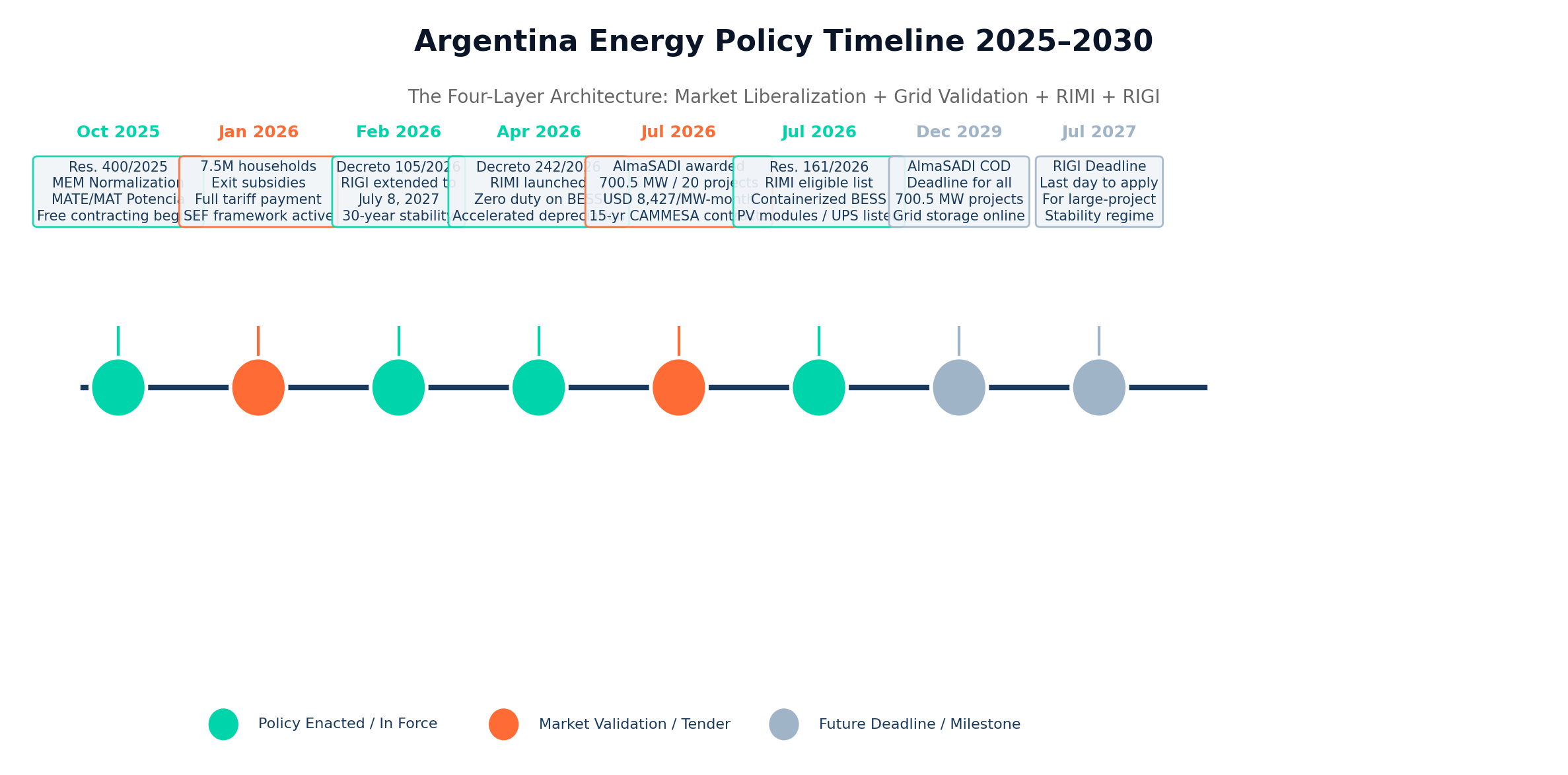
In October 2025, the government liberalized the wholesale electricity market. In January 2026, 7.5 million households lost their subsidies and started paying real tariffs. In July 2026, the national AlmaSADI tender awarded 700.5 MW of battery storage at an average price of USD 8,427 per MW-month. The tender was 12x oversubscribed. That is not a pilot. That is a market validation.
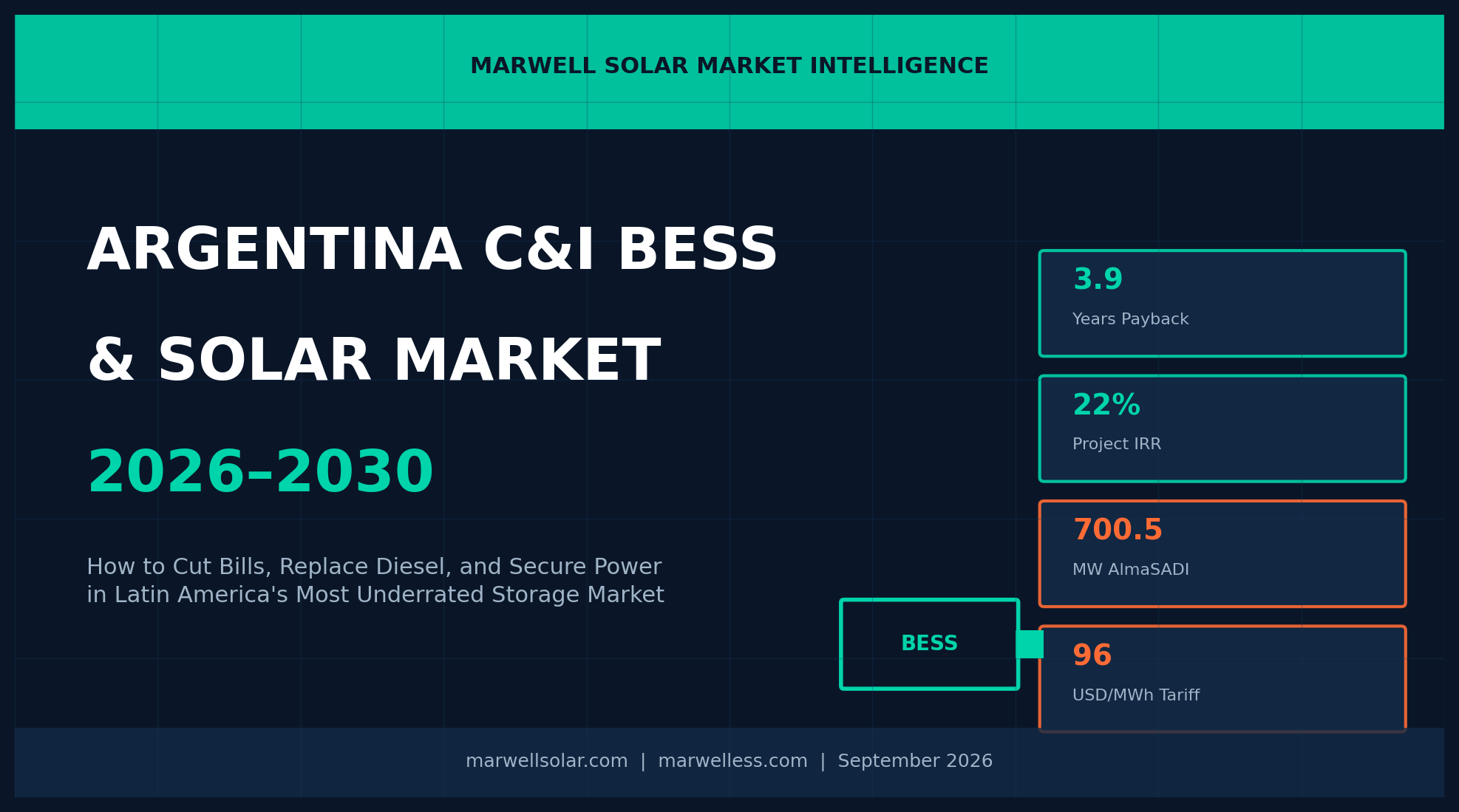
For commercial and industrial owners, the numbers are now impossible to ignore. An 800 kW solar array plus a 1 MW / 2 MWh battery pays back in roughly 3.9 years at about 22% IRR. A lithium mine running diesel at 250-350 USD per MWh can cut that cost by two-thirds with a hybrid microgrid. The gap between what industrial users currently pay and what they could pay with on-site storage is the opportunity. And it is closing fast.
Here is what is actually happening on the ground.
Three Things Hitting at Once
The lithium triangle is electrifying. Jujuy, Salta, and Catamarca hold roughly 50 lithium projects with over USD 8 billion in announced investment. Mines like Cauchari-Olaroz and Rincon sit at 3,600-4,200 meters on the Puna plateau, far from the national grid backbone. Most still burn diesel for baseload power. The full cost, including fuel transport to altitude, runs 250-350 USD per MWh. That is not an environmental problem. That is a cost problem. And solar-plus-storage-plus-diesel hybrid microgrids are the fix.
The grid is unreliable where industry actually lives. Official ENRE audits for the second half of 2024 show Edesur, the distributor covering southern Buenos Aires and the industrial belt, averaged 7.37 hours of outages per six months. Some areas hit 38 hours. For a food plant or injection molding line worth USD 5,000-20,000 per operating hour, that is USD 40,000-300,000 in lost production every year. A battery system costs less than the annual losses.
Policy crossed the line from incentive to infrastructure. RIMI, launched in April 2026, gives medium-sized investors three things: accelerated depreciation, early VAT refunds, and zero import duty on battery containers, PV modules, inverters, and UPS. There is no minimum investment threshold for energy equipment. RIGI, extended to July 2027, offers 30-year regulatory stability, a flat 25% income tax, and FX benefits for large projects. AlmaGBA and AlmaSADI, two tenders totaling 1,413.5 MW, proved that storage has a bankable, formal role in Argentina’s power system. The framework is done. The question is who moves first.
Where Your Money Is Leaking
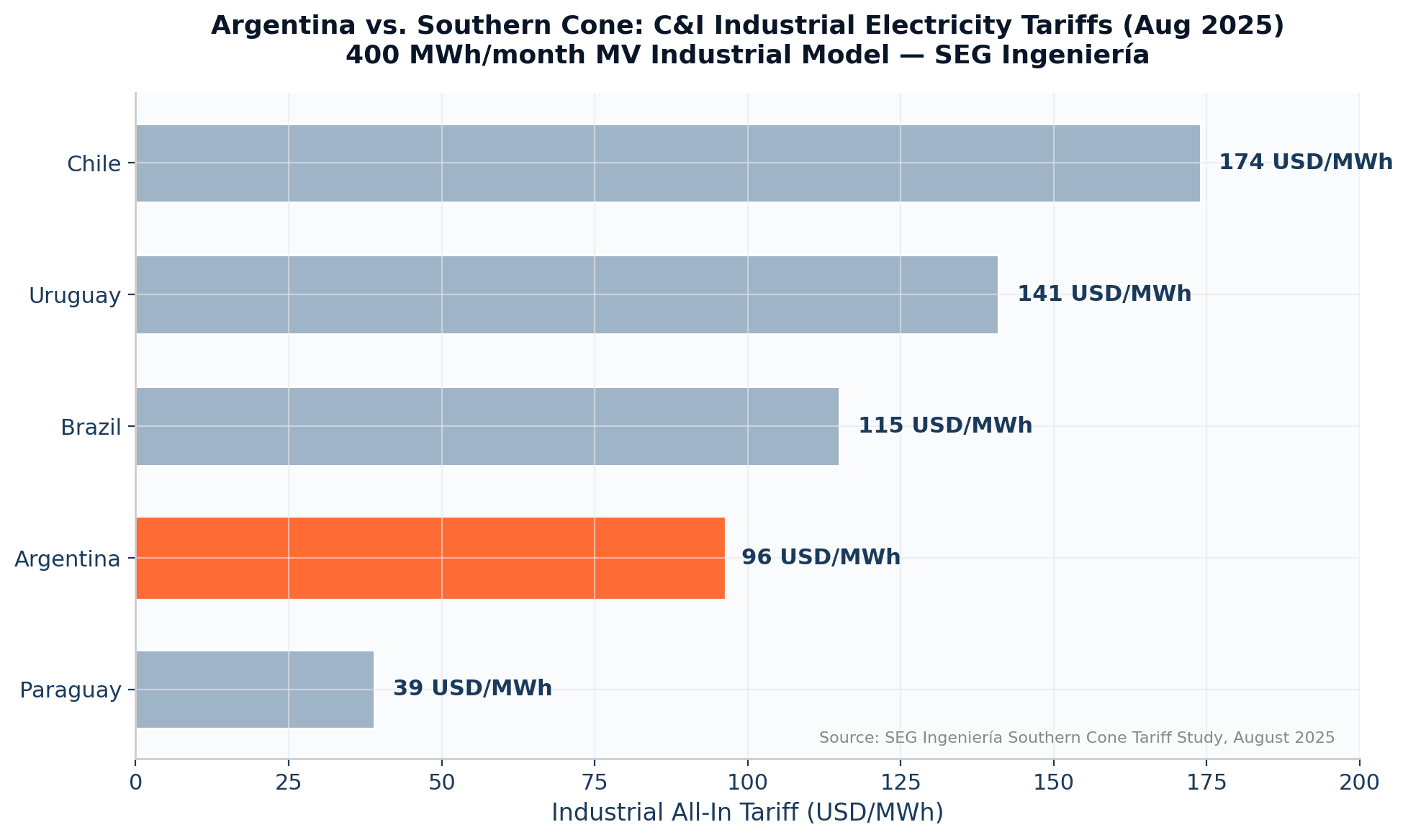
Argentina’s medium-voltage industrial tariff looks cheap on paper. About 96 USD per MWh, well below Chile at 174 or Uruguay at 141. But that number is converging fast, and it hides four much larger costs that storage attacks directly.
First, winter spot price exposure. Under the new market rules, large industrial users face wholesale prices directly. Winter peaks are forecast at 90-120 USD per MWh, with seasonal spreads reaching 3.1x. If you do not have a hedge, you eat that volatility raw.
Second, outage losses. In the Edesur zone, the average industrial facility sees about 8 unplanned outages and 15 outage hours per year. For cold storage, data centers, or continuous manufacturing, every minute off the grid is a direct hit to revenue.
Third, diesel self-generation. Outside the main grid and in mining areas, diesel gensets provide backup or baseload at 250-350 USD per MWh. Buenos Aires Province has already decided to replace its summer diesel program with batteries. That is a government telling you diesel is too expensive.
Fourth, power factor and demand penalties. Industrial tariffs include surcharges for low power factor and contracted demand overruns. A four-quadrant battery inverter handles both reactive compensation and peak shaving, eliminating those line items entirely.
The Math: Solar Plus BESS Wins Every Time
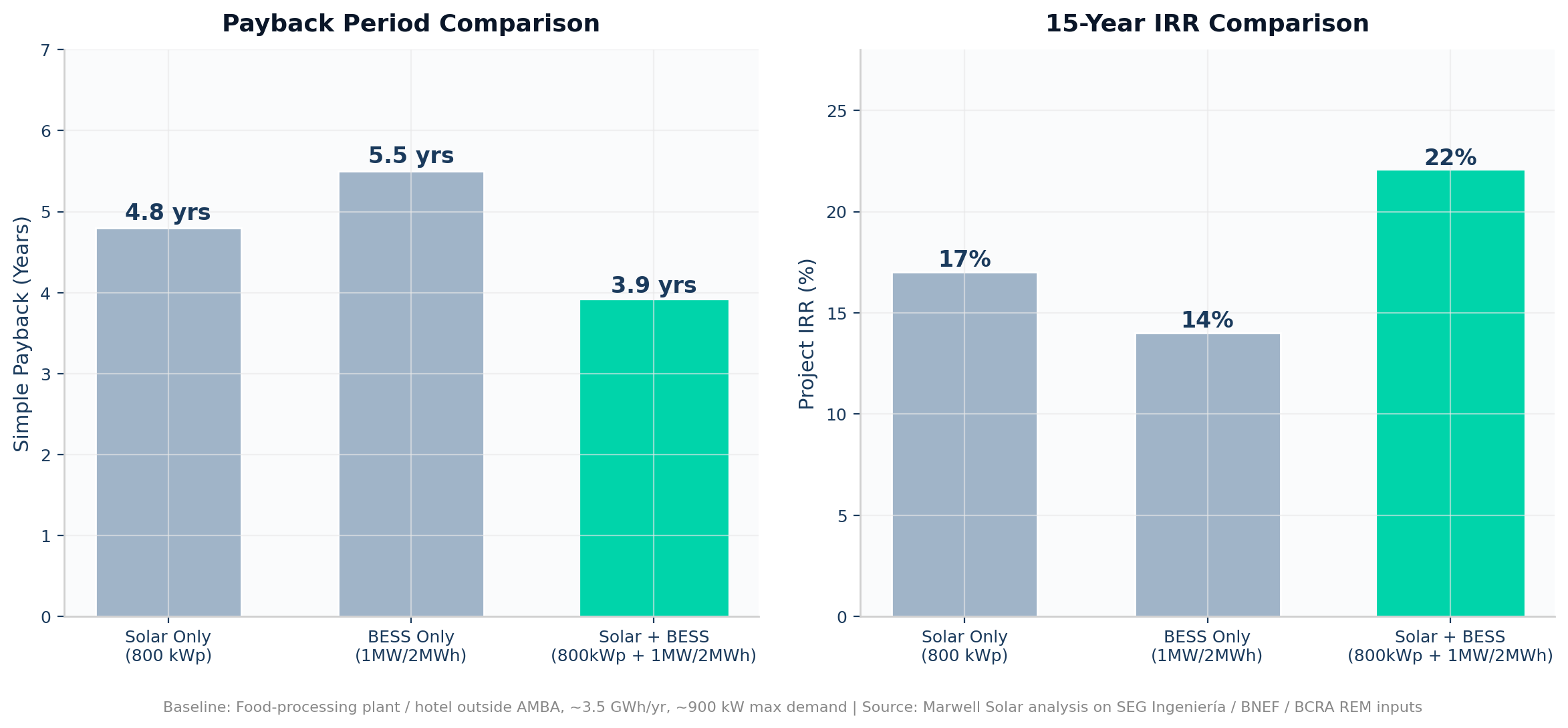
We modeled three setups for a typical food plant or hotel outside the capital region. Annual consumption around 3.5 GWh, peak demand around 900 kW.
Solar only, 800 kW. Investment about USD 620,000. Payback roughly 4.8 years. It saves energy costs but leaves you fully exposed to outages and winter price spikes.
Battery only, 1 MW / 2 MWh. Investment about USD 850,000. Payback roughly 5.5 years. It cuts demand charges and captures some arbitrage, but it ignores the free energy sitting on your roof.
Solar plus battery, 800 kW plus 1 MW / 2 MWh. Investment about USD 1.32 million. Payback roughly 3.9 years. IRR about 22%. Over 15 years, the net present value is roughly USD 1.05 million. That is more than double either standalone option.
Why does the combination work so well in Argentina? Because no other market in Latin America stacks high tariffs, high outage losses, and high winter spot spreads at the same time. The total addressable value for behind-the-meter storage is far larger than the nominal tariff suggests.
Eight Industries, One Answer
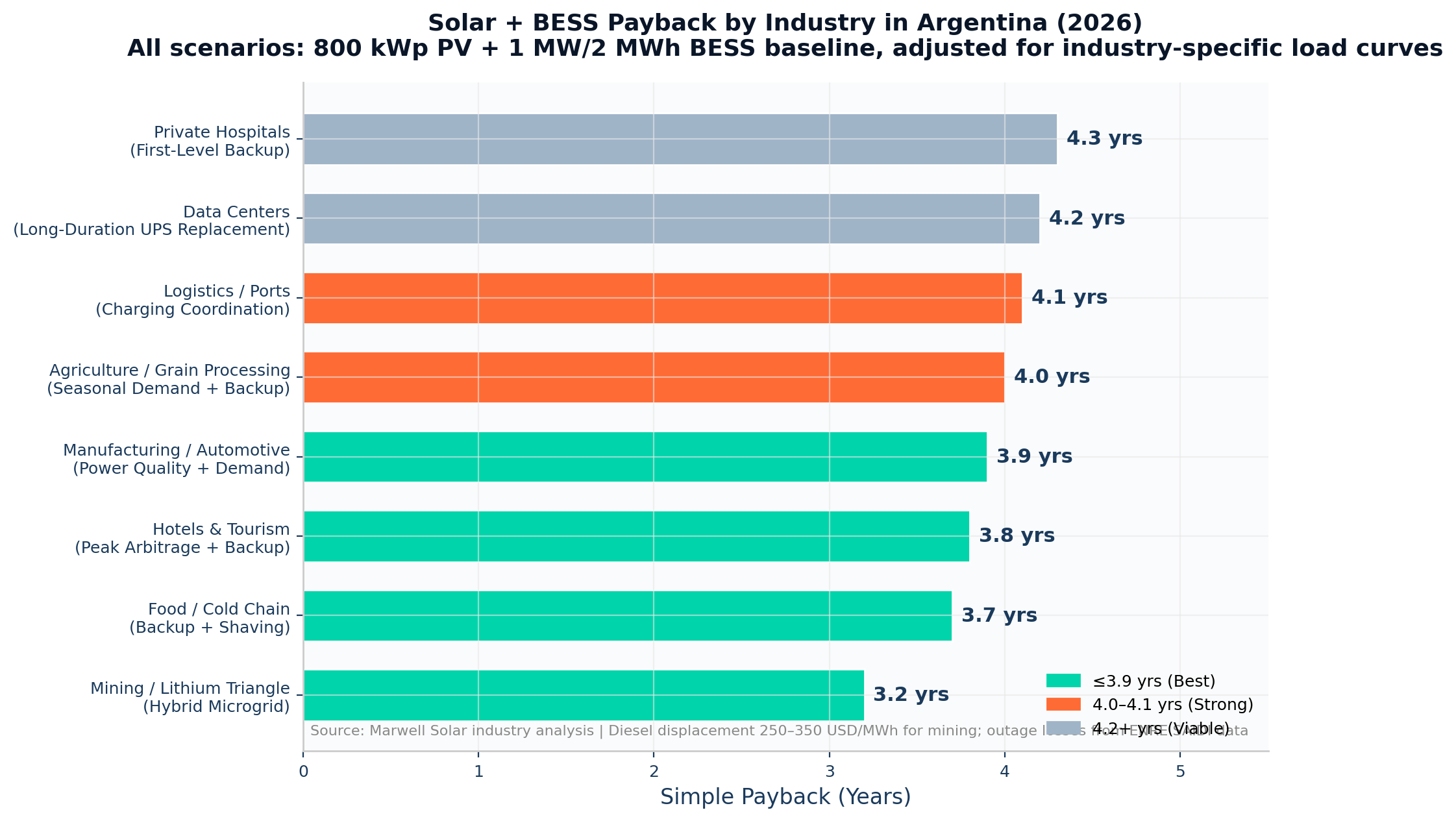
We looked at eight C&I segments. In every single one, solar plus battery delivers the shortest payback. The only thing that changes is what the battery is primarily doing.
For mining and the lithium triangle, payback is about 3.2 years. The battery is a diesel displacer. That is the highest-value application in the country.
For food processing and cold chain, about 3.7 years. The battery is an insurance policy against a broken cold chain. One two-hour outage can ruin a frozen warehouse.
For manufacturing and automotive, about 3.9 years. The battery is a power quality firewall. A 100-millisecond voltage sag can halt a robotic line for hours.
For hotels, about 3.8 years. Evening peak arbitrage plus outage protection during high season. For data centers, about 4.2 years, replacing legacy UPS and cutting generator runtime by 60-80%. For agriculture, logistics, and hospitals, payback ranges from 4.0 to 4.3 years.
The technology is not the differentiator. Lithium iron phosphate, liquid cooling, and a four-stack energy management system is the standard. What separates a good project from a bad one is altitude derating for high-altitude mines, fire certification that insurers actually accept, and grid codes written into the EPC contract rather than argued about after commissioning.
The 18-Month Roadmap
2026 and 2027 are the overlap of a policy window and a cost trough. First movers lock in three scarce resources: RIMI qualification, quality rooftops, and interconnection capacity.
Months 0 to 2: Diagnosis. Collect 12 months of 15-minute load data. Quantify outage losses against official ENRE regional statistics. Survey your roof or land. Define your revenue stack.
Months 2 to 4: Structuring. Build your USD-peso financing. Apply for RIMI qualification and RENPALMA registration. Shortlist two or three EPCs with actual Argentina track records. Confirm your equipment is on the RIMI eligible list before you order.
Months 4 to 6: Contracting. Negotiate the EPC contract with interconnection milestones, a performance warranty that caps annual degradation at 2% and guarantees 80% state of health at year 5, and a local service SLA. Lock in insurance. Write the contract in USD.
Months 6 to 14: Delivery. Place the equipment order with a 90-to-120-day logistics buffer. Build and interconnect. Commission the energy management system with four active strategies: peak shaving, spot arbitrage, seamless backup transfer, and diesel hybrid coordination.
Month 14 onward: Operation. Review performance quarterly. Refine arbitrage strategies as the bilateral market matures. Evaluate expansion at year three. Turn your operating data into a case study that unlocks cheaper secondary financing.
The Bottom Line
Argentina’s C&I storage window is the convergence of four lines: subsidy removal pushing tariffs up, market liberalization opening channels, RIMI and RIGI cutting project costs, and AlmaSADI proving the model works at scale. Companies that get their first projects built in 2026 and 2027 lock in the largest value stack at the lowest equipment cost.
For owners, the question is no longer whether solar-plus-storage works in Argentina. AlmaSADI answered that. The question is whether you get your interconnection application in before the queue fills up.
For EPCs and distributors, the bridge between Chinese manufacturing costs and Argentine local execution is the business. The equipment cost curve has crossed the threshold. The policy framework is in force. The competition is thin.
Build the bridge now.
About Marwell Solar
Marwell Solar provides commercial and industrial outdoor battery cabinets from 100 kW to multi-MW, 20-foot liquid-cooled containerized systems at roughly 5 MWh per unit, and turnkey solar-plus-storage-plus-diesel hybrid microgrids. Our containerized BESS format matches the exact technical description in Argentina’s RIMI zero-duty eligible goods list. We have over ten years of industry experience, multiple overseas branches, and active Latin America expansion from 2026.
If you are evaluating energy costs, outage risk, or diesel replacement for a facility in Argentina, contact us for a project-specific assessment based on your actual load data.
marwellsolar.com | marwelless.com
Frequently Asked Questions
How much does industrial electricity cost in Argentina?
About 96 USD per MWh all-in for a medium-voltage industrial user consuming roughly 400 MWh per month. Winter wholesale spot peaks reach 90-120 USD per MWh, with seasonal asymmetry up to 3.1x. Tariffs are rising as subsidies phase out.
What is the payback for a C&I battery system in Argentina?
For a typical industrial or hotel load, an 800 kW solar array plus 1 MW / 2 MWh battery pays back in roughly 3.9 years at about 22% IRR. Solar-only is about 4.8 years. Battery-only is about 5.5 years. For mining diesel displacement, payback drops to roughly 3.2 years.
What incentives exist for energy storage in Argentina?
RIMI grants zero import duty, accelerated depreciation, and early VAT refunds for listed goods including containerized batteries, PV modules, inverters, and UPS, with no minimum investment for energy equipment. RIGI offers 30-year regulatory stability, a flat 25% income tax, and FX benefits for projects above USD 200 million.
What is AlmaSADI?
Argentina’s national battery storage tender, launched in February 2026 with a 700 MW target. It received 235 offers totaling 8,338 MW and awarded 700.5 MW to 20 projects under 15-year CAMMESA contracts at a weighted average of USD 8,427 per MW-month.
How reliable is Argentina’s grid for factories and hospitals?
Official ENRE audits show Edesur, covering the southern Buenos Aires industrial belt, at 4.12 outages and 7.37 hours per half-year, failing regulatory limits in every municipality. Some localized areas reached 38 outage hours. A December 2025 event cut power to roughly 1.08 million Edesur users simultaneously.
Who supplies C&I battery and solar-plus-storage solutions in Argentina?
Marwell Solar provides C&I battery cabinets, 20-foot liquid-cooled containerized systems, and turnkey hybrid microgrids. Our equipment format matches Argentina’s RIMI zero-duty eligible goods list, and we are actively deploying in the Argentine market from 2026.
This article was compiled from public policy documents, SEG Ingeniería tariff data, ENRE audit statistics, and Marwell Solar project economics as of September 2026. Cost and revenue figures are indicative models — for specific projects, always use actual load data and formal engineering assessment.