
Mexico C&I Storage: Eat Now, or Starve in Three Years?
How CFE demand charges, regional tariffs and the 2026 CNE storage policy decide who wins Mexico’s commercial & industrial battery market — and who pays the latecomer tax.
By Ethan, Commercial Director at Marwell Solar
Last month a guy running an auto-parts plant in Chihuahua hit me up. Two years ago he put rooftop solar on his factory. Yearly bill? Still pushing twenty million pesos.
I asked for his last twelve months of CFE bills. Took one look and laughed.
The solar was doing its job — cutting daytime energy, no problem. The killer was 6:00 p.m. to 10:00 p.m., GDMTH Punta window. Sun’s gone, production lines still running, AC still blasting, then one air compressor kicks in. Boom. That 15-minute interval locks in his peak demand for the whole month. Three hundred thousand pesos in capacity charges, gone. Just like that.
He saved money on energy with solar, then gave it all back — and then some — on demand charges he never saw coming.
At Marwell Solar, we run into this story every week. The data is sitting right there in the bill. Most owners just never look.
Most People Get This Wrong: Storage Isn’t for Saving Electricity. It’s for Shaving Peaks.
How many times do I have to say this?
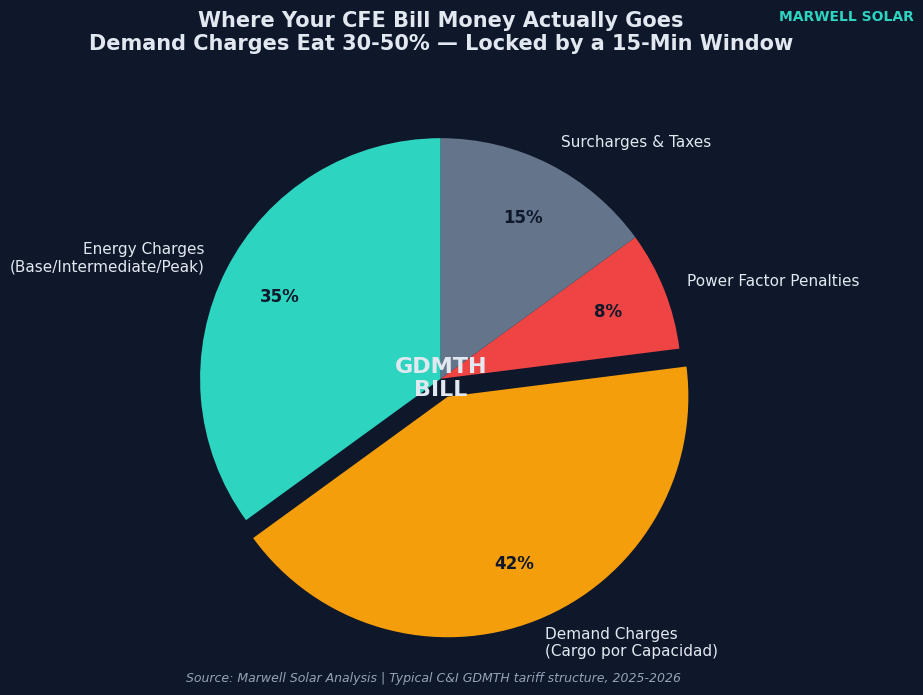
CFE doesn’t bill you on total kilowatt-hours. They bill you on the maximum power you drew in any 15-minute window. Once that number is recorded, your monthly capacity charge (Cargo por Capacidad) is set. Doesn’t matter if you ran at half that load for the other twenty-nine days.
So the real value of a battery isn’t “store cheap power at midnight, use it at noon.” That’s pocket change. The real value is this: your EMS sees the next 15-minute window is about to spike, and the battery dumps power in milliseconds to flatten that peak.
Flatten it once, save three hundred thousand pesos. Do it a dozen times a year, you’re looking at three or four million.
Here’s the catch, though: a generic EMS — the kind that ships out of a catalog and gets dropped into any country — usually bombs on GDMTH’s dual demand logic. It doesn’t know how to read the 15-minute sliding window, doesn’t know the difference between capacity and distribution charges, and ends up missing the spike half the time.
At Marwell, we built our EMS specifically for Mexico’s metering rules. We backtest it against your actual load history before we ever quote hardware. Because shaving a peak you miss is just expensive theater.
Arbitrage is the cherry on top. Peak shaving is the steak.
Why Do Cancún Hotels Pay Back Fastest? Because the Tariffs Are Insane.
Here are two numbers.
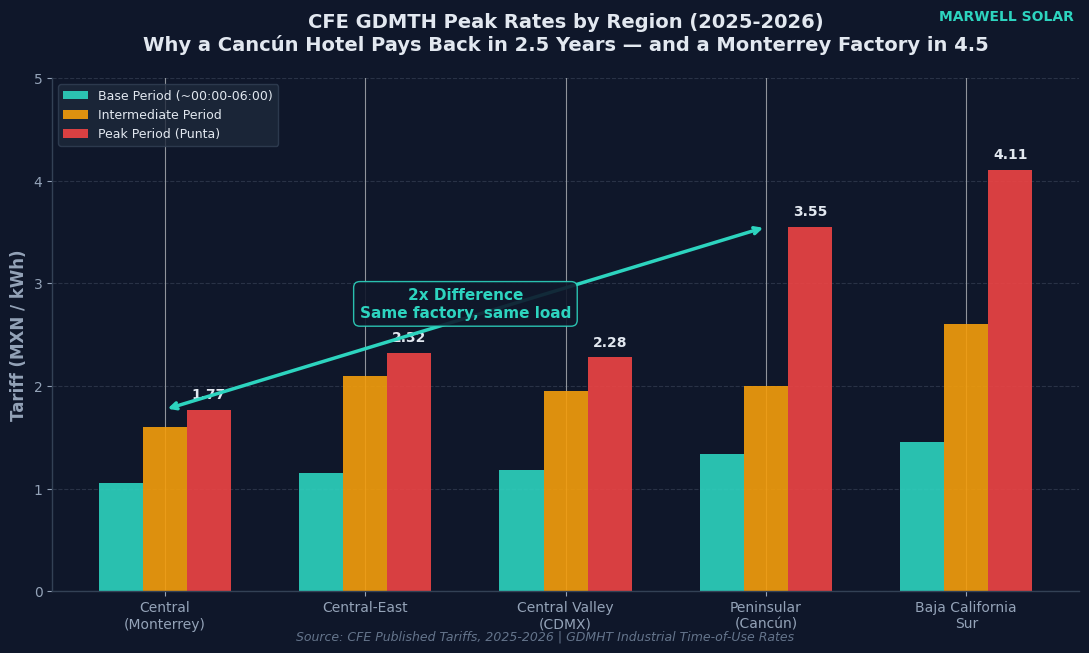
Monterrey, Punta period: roughly 1.77 MXN/kWh. Cancún? 3.55. Baja California Sur? Over 4.1. Same battery pack. Same cycle. In Monterrey you’re earning maybe seven hundred thousand pesos a year on arbitrage. In Cancún, one point four million.
That’s why that big resort in Cancún — commissioned back in 2023 — is now saving roughly MXN 104 million a year. It’s not a case study. It’s a math problem, and the spread solved it.
But don’t copy-paste that setup into a Monterrey factory and expect the same result. Payback doubles. Why? The peak-to-valley spread is half as wide. The arbitrage ceiling is cut in half.
So don’t start with “how much for 2 MWh?” Start with: what does my load curve look like? What’s my Punta rate? When do my 15-minute peaks actually hit?
Anyone who quotes you hardware before looking at your load data is selling you a religion, not a system.
Policy Turned Green in 2026. Hardware Didn’t Get the Memo.
April 16, 2026. CNE drops DACG Almacenamiento. Storage finally has a legal seat at the table. SAEE-CC — behind-the-meter storage, no export to grid, no generation permit, just file and go.
Sounds smooth, right?
Smooth on paper. But here’s the thing nobody talks about at the press conference: lead times for transformers and medium-voltage switchgear are already eighteen to thirty-six months.
The policy window is open. The supply-chain window is closing. Queue early, lock your price early. By 2028, co-storage mandates kick in for all new wind and solar — thirty percent of capacity, three-plus hours duration. Planned demand from that rule alone: 574 MW+. When that wave hits, good luck finding available gear, a decent install crew, or a price that isn’t padded.
Policy dividends go to the early movers. Latecomers get to pay the latecomer tax.
Solar + Storage Isn’t 1+1=2. It’s 1+1=4.
Existing solar owners ask me all the time: “I already have PV. Does adding storage make sense?”
Yes. But only if you understand where PV falls on its face.
Solar peaks at noon. Your Punta window is 6:00 p.m. to 10:00 p.m. — sun’s already down. That surplus midday generation? You either sell it back to the grid at a lousy rate, or you waste it. Add a battery, store that surplus, discharge it during Punta, and your self-consumption rate jumps from ~35% to 85%+.
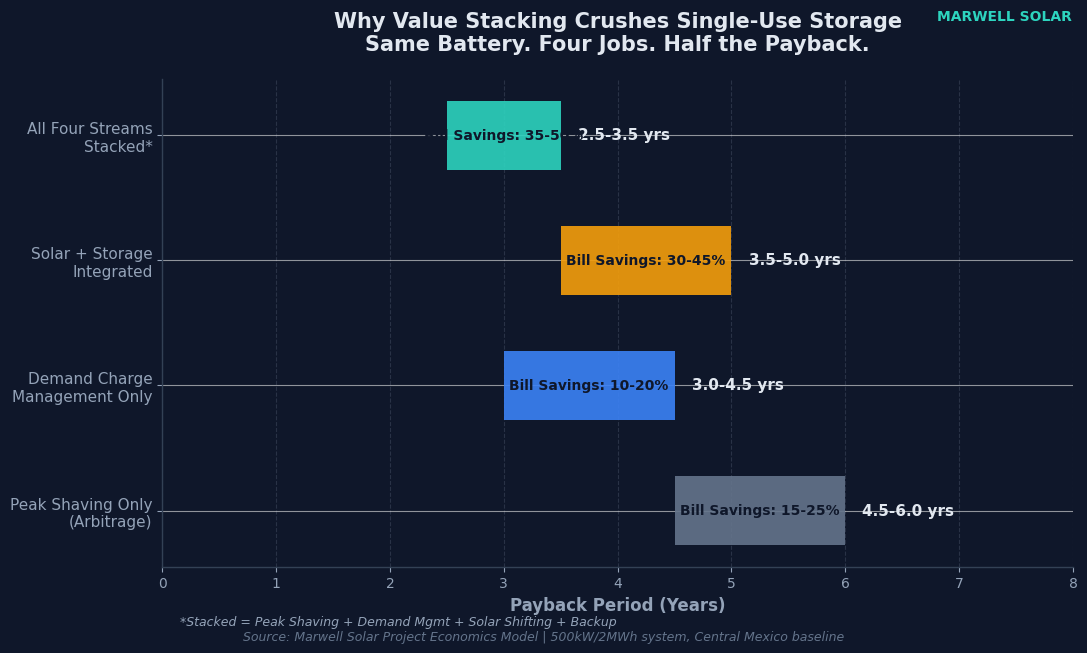
Stack that with peak shaving and backup power. Four revenue streams running on the same asset. Payback drops from six years (arbitrage only) to three and a half. In high-tariff zones like Cancún, two and a half to three years.
Storage as a single-use toy? That’s a luxury. Storage as a value-stacking machine? That’s a cash printer.
So How Do You Actually Start?
Honestly? Step one costs you nothing.
Pull your last twelve months of CFE bills. Export your 15-minute load data. Without that data, everything else is just talk. With it, we backtest: where do your peaks land? How many kilowatts can we shave? How much demand charge disappears? What’s the arbitrage upside? Run three scenarios — base case, conservative, aggressive — and let the numbers vote.
I’ve seen too many bosses take delivery on equipment before they realize the config was wrong. PCS undersized, so peak shaving misses. Battery oversized, so capacity sits idle most days, dragging payback out for no reason. Or worse: they bought air-cooled cabinets for a plant in Sonora where summer hits 45°C, and now the system derates half the year.
Bigger isn’t better. Power at 25–40% of your max demand. Capacity at 2–4x that power. Leave headroom for year-three expansion. That’s the sweet spot.
And if you’re operating anywhere with real heat, coastal salt, or sketchy grid voltage — which describes most of Mexico outside CDMX — spec IP54 / C4 protection and liquid cooling. At Marwell, we don’t even quote air-cooled for northern or peninsular sites anymore. The downtime math doesn’t work.
The One Thing That Still Keeps Me Up at Night
It’s not the battery. Batteries are a commodity now.
It’s the handoff. I’ve watched projects where the battery guy blames the PCS guy, the PCS guy blames the installer, the installer says the civil engineer got the pad wrong, and the owner is left holding a million-dollar paperweight.
That’s why Marwell runs Turnkey EPC. One contract. One throat to choke. From your 12-month bill backtest, through design, manufacturing, shipping, customs, installation, CNE filing, and 15-year O&M. If the system doesn’t shave what we promised, you don’t get passed around a blame chain. You call one number.
Numbers don’t lie. But finger-pointing does.
Frequently Asked Questions
Is a 3-year payback actually realistic?
In high-tariff regions like Cancún or Los Cabos, with stacked value streams — peak shaving + arbitrage + solar shifting — 2.5 to 3.5 years is a real number. In Central Mexico, figure 3.5 to 4.5 years. Pure backup-only scenarios rarely pencil out unless you monetize avoided outage losses.
What’s the difference between SAEE-CC and Autoconsumo?
SAEE-CC is behind-the-meter storage with no grid export. No generation permit required. Autoconsumo pairs storage with on-site generation and covers 0.7–20 MW under the simplified permit process. If you’re adding storage to existing PV without changing interconnection capacity, SAEE-CC is usually the faster path.
I already have solar. Is adding storage complicated?
If it’s a pure retrofit — storage charges and discharges behind the meter, no export, no capacity increase — you can typically file under SAEE-CC without touching your original self-supply permit. If you’re expanding interconnection capacity or export power, re-papering through the one-stop window is the cleaner route.
Does Mexican heat affect system choice?
Yes. Northern Mexico and the Peninsula regularly exceed 45°C in summer. Air-cooled systems derate significantly. We spec liquid-cooled outdoor cabinets rated IP54 / C4 or higher. Warranty terms should explicitly cover high-temperature operation — if they don’t, you’re buying a problem.
Are the cost figures in this report still current?
Based on 2025–2026 market data. Battery pack prices move with ocean freight, import duties, and peso–dollar exchange rates, so landed costs lag the global spot price. The directional trend — down — is solid, but always run fresh numbers for your specific project.
What does Marwell Solar actually deliver?
Turnkey EPC: bill backtesting, system design, equipment manufacturing, international logistics, customs clearance, installation, commissioning, interconnection filing, and long-term O&M. For multi-site clients — hotel chains, retail rollouts — we run standardized configs with centralized remote monitoring. If you want zero capex, we can structure leasing or ESaaS through our partner network.
This article was compiled from public policy documents, CFE tariff data, and Marwell Solar project economics as of August 2026. Cost and revenue figures are indicative models — for specific projects, always use actual load data and formal engineering assessment.